
How Long Does a Michigan Lemon Law Case Take?
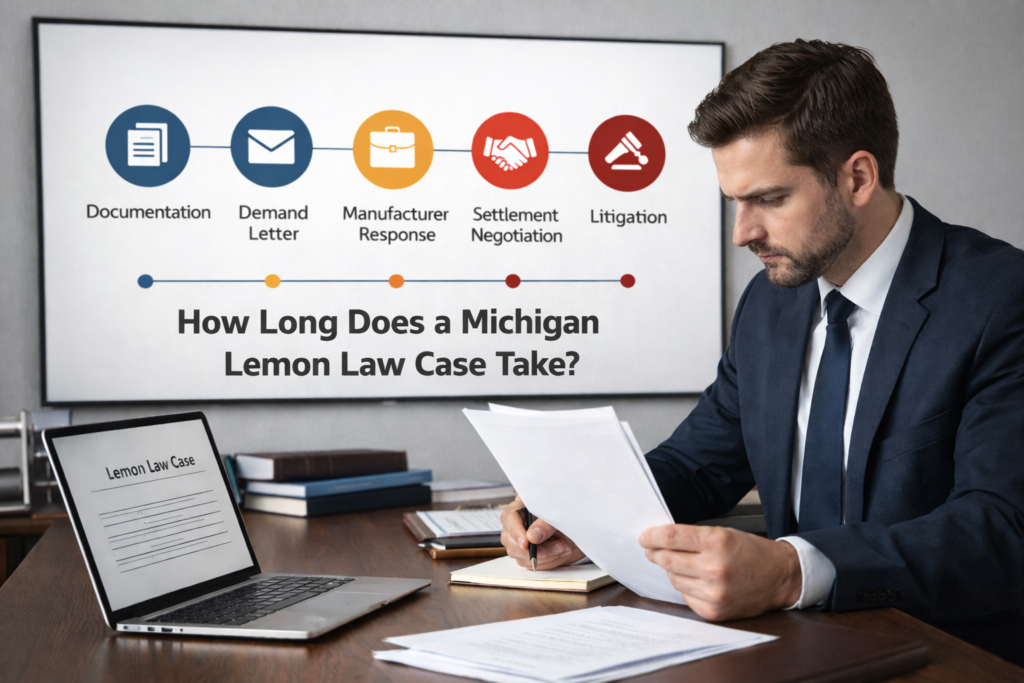
You’ve been back to the dealership four times. The same problem keeps happening. You know your car is a lemon, and you’re ready to do something about it. But before you commit to pursuing a lemon law claim, you have one critical question: How long is this going to take? You can’t afford to be without a car for months. You don’t want to be stuck in legal limbo for a year. You need to know what you’re getting into. The good news: Most Michigan lemon law cases resolve in 3-5 months with an experienced attorney. You won’t be dragged through endless litigation. The process is designed to be relatively fast and consumer-friendly. This comprehensive guide will walk you through every phase of a Michigan lemon law case, explain how long each step typically takes, show you what can speed up or slow down the process, and give you realistic expectations for your timeline. The Short Answer: 3-5 Months for Most Cases If you hire an experienced Michigan lemon law attorney and have a legitimate case with proper documentation, the average timeline from start to finish is: 3 to 5 months This assumes: Some cases resolve faster (6-8 weeks). Others take longer (6-12 months), especially if litigation becomes necessary. Let’s break down each phase so you know exactly what to expect. Phase 1: Documentation and Attorney Evaluation (2-4 Weeks) The first step is gathering all your records and having an attorney evaluate your case. What Happens in This Phase Week 1-2: You Gather Documentation You’ll need to collect: Most of this is in your glovebox, email, or available by requesting records from the dealership. Week 2-3: Free Consultation with an Attorney You’ll meet with (or speak to) a Michigan lemon law attorney who will: Week 3-4: Attorney Performs Case Investigation If the attorney takes your case, they’ll: Timeline: 2-4 Weeks If you have your documentation organized, this phase can be as short as 2 weeks. If records need to be tracked down or the dealer is slow to respond, it can stretch to 4 weeks. How to Speed Up This Phase ✅ Organize your paperwork before contacting an attorney ✅ Request service records from the dealer immediately (don’t wait for your attorney to do it) ✅ Be responsive when your attorney asks for additional information Phase 2: Attorney Evaluation & Demand Letter (1-2 Weeks) Once your attorney has completed their investigation, they’ll prepare and send a formal demand letter to the manufacturer. What Happens in This Phase The Demand Letter Includes: Why the Demand Letter Matters The demand letter puts the manufacturer on formal legal notice that you’re pursuing a lemon law claim. It signals: Most manufacturers take demand letters seriously, especially when they come from experienced lemon law attorneys with a track record of winning cases. Timeline: 1-2 Weeks Drafting and sending the demand letter typically takes 1-2 weeks after the attorney completes their case evaluation. Phase 3: Manufacturer Response Window (30 Days) Once the manufacturer receives the demand letter, Michigan law and basic legal practice give them 30 days to respond. What Happens in This Phase The manufacturer’s legal team will: Possible Manufacturer Responses 1. Settlement Offer The manufacturer offers a buyback, replacement, or cash settlement. This is the most common response when the case is strong. 2. Counteroffer or Negotiation The manufacturer acknowledges your claim but disputes the amount or terms. Negotiation begins. 3. Denial The manufacturer denies that your vehicle qualifies as a lemon. This often leads to arbitration or litigation. 4. Request for More Information The manufacturer asks for additional documentation or clarification. This can extend the timeline by 2-4 weeks. Timeline: 30 Days (4 Weeks) Expect to wait about a month for the manufacturer’s initial response. During this time, your attorney will likely follow up to ensure the manufacturer received the letter and is actively reviewing the case. Phase 4: Negotiated Settlement (4-8 Weeks) If the manufacturer makes a settlement offer—or engages in negotiation—this is where most Michigan lemon law cases resolve. What Happens in This Phase Your attorney negotiates on your behalf to: The manufacturer’s goals: Typical Settlement Outcomes Buyback (Repurchase) Replacement Vehicle Cash Settlement (Magnuson-Moss) How Long Negotiation Takes Best case: 2-4 weeks if the manufacturer makes a fair initial offer. Average case: 4-6 weeks as your attorney and the manufacturer go back and forth on terms. Worst case: 8+ weeks if the manufacturer lowballs, delays, or disputes key facts. Statistics: Most Cases Settle Here 60-75% of Michigan lemon law cases settle during the negotiation phase, without ever going to arbitration or court. Why? Because: If you have an experienced attorney and solid evidence, the manufacturer knows they’re likely to lose in court—so settlement makes financial sense for them. Timeline: 4-8 Weeks From the manufacturer’s initial response to final settlement, expect 4-8 weeks of negotiation. Phase 5: Michigan Vehicle Arbitration Committee (MVAC) – If Negotiation Fails (30-60 Days) If settlement negotiations break down, the next step is often arbitration through Michigan’s Motor Vehicle Arbitration Committee (MVAC). What Is MVAC? MVAC is a state-run arbitration program that hears lemon law disputes. It’s an alternative to going to court—faster and less formal, but still legally binding. How MVAC Works 1. You File a Claim Your attorney submits a formal arbitration claim to MVAC. 2. The Manufacturer Responds The manufacturer has 20 days to file a written response. 3. Arbitration Hearing A hearing is scheduled (typically 30-45 days after filing). Both sides present evidence: 4. MVAC Decision The arbitrator issues a binding decision, typically within 10-14 days of the hearing. What MVAC Can Award If MVAC finds in your favor, they can order: Timeline: 30-60 Days (Total) MVAC vs. Court MVAC is faster and less expensive than going to court, but it has drawbacks: Your attorney will advise whether MVAC arbitration or litigation is the better path for your case. Phase 6: Litigation (6-18 Months) – When All Else Fails If settlement negotiations fail and arbitration doesn’t produce a fair result (or isn’t pursued),
Michigan Lemon Law vs. Magnuson-Moss Act
Your car started having transmission problems 13 months after you bought it. You’ve been back to the dealership three times, and the issue still isn’t fixed. You mention “lemon law” to the service advisor, and they shake their head. “Sorry, you’re outside Michigan’s lemon law window. Nothing we can do.” You leave frustrated, thinking you’re stuck with a defective vehicle for the next several years. Here’s what the service advisor didn’t tell you: You still have federal protection under the Magnuson-Moss Warranty Act. Michigan has one of the shortest lemon law protection windows in the United States—just one year. But the Magnuson-Moss Warranty Act is a powerful federal law that extends protection as long as your manufacturer’s warranty is active. Most Michigan consumers have never heard of Magnuson-Moss. Dealerships and manufacturers certainly won’t tell you about it. But it’s the law—and it can provide relief when Michigan’s state lemon law no longer applies. This comprehensive guide will explain Michigan’s lemon law limitations, how the Magnuson-Moss Warranty Act works, the key differences between the two laws, and how to use federal law to hold manufacturers accountable even after Michigan’s 1-year window closes. Michigan’s Lemon Law: One of the Shortest Windows in America Michigan’s lemon law is found in the Motor Vehicle Warranty Act (Act 87 of 1986). It provides strong consumer protections—but only for a limited time. Michigan’s 1-Year Limitation Michigan’s law applies if defects first appear within: 1 year from the date of delivery to the consumer. After that first year, Michigan’s state lemon law no longer applies—even if your vehicle is still under the manufacturer’s warranty. Why This Is a Problem Most new vehicles come with a 3-year/36,000-mile basic warranty and longer powertrain warranties (5 years/60,000 miles is common). So what happens when: Under Michigan state law, you’re out of luck. The 1-year window has closed. But under federal law, you’re still protected. Only Seven States Have Shorter Windows Michigan’s 1-year lemon law window ties it for 7th shortest in the nation. For comparison: Michigan consumers get far less protection than residents of most other states. This is where the Magnuson-Moss Warranty Act becomes critical. What Is the Magnuson-Moss Warranty Act? The Magnuson-Moss Warranty Act is a federal consumer protection law enacted in 1975. It applies to all consumer products sold with a written warranty, including motor vehicles. Key Features of Magnuson-Moss 1. Nationwide Coverage Magnuson-Moss is federal law. It applies in all 50 states, including Michigan. 2. Applies to Any Warranted Product Over $25 If a product costs more than $25 and comes with a written warranty (which all new vehicles do), Magnuson-Moss applies. 3. Protects Consumers During the Full Warranty Period As long as your manufacturer’s warranty is active—whether it’s 3 years, 5 years, or longer—you’re protected under federal law. 4. Requires Manufacturers to Honor Warranties If a manufacturer provides a written warranty, Magnuson-Moss requires them to actually fix the defect or provide compensation if they can’t. 5. Includes Fee-Shifting Like Michigan’s lemon law, Magnuson-Moss includes a fee-shifting provision. If you win your case, the manufacturer pays all your attorney’s fees. Why Most Consumers Don’t Know About It Magnuson-Moss is powerful, but it’s rarely discussed because: But Magnuson-Moss is just as enforceable as state lemon law—and in many cases, it provides better options for consumers. How Magnuson-Moss Differs from Michigan Lemon Law While both laws protect consumers with defective vehicles, there are key differences. Feature Michigan Lemon Law Magnuson-Moss Warranty Act Time Window 1 year from delivery Full warranty period (typically 3-5 years) Repair Attempts 4 attempts for same defect Reasonable number (often 3 or fewer in practice) Out-of-Service Days 30 cumulative days Not specifically defined (reasonable number) Primary Remedy Buyback or replacement Cash compensation (while keeping vehicle) Covers Used Cars? No (separate used car law) Yes, if original warranty still active Attorney Fees Manufacturer pays if you win Manufacturer pays if you win Jurisdiction Michigan state courts Federal or state courts The Most Important Difference: Cash Compensation Under Michigan’s state lemon law, the manufacturer must either: Under Magnuson-Moss, the typical remedy is: Cash compensation for the diminished value of the vehicle—while you keep the car. This is a huge advantage if: You receive a settlement check and keep driving your car—and the manufacturer must continue honoring the warranty and attempting repairs. Magnuson-Moss Covers Defects That Appear After Michigan’s 1-Year Window This is the game-changer for Michigan consumers. Real-World Scenario You buy a 2023 Ford Explorer in January 2023. Under Michigan lemon law: You’re outside the 1-year window. No state law protection. Under Magnuson-Moss: Your vehicle is still under Ford’s 3-year/36,000-mile basic warranty. The defect first appeared during the warranty period. You’ve had 3 repair attempts. You have a federal lemon law claim. Critical Trigger: Reasonable Repair Attempts Magnuson-Moss requires a reasonable number of repair attempts for the same substantial defect—often interpreted as 3 or fewer in many courts (more favorable than Michigan’s 4-attempt requirement). So even if you’re outside Michigan’s 1-year window, if you’ve had reasonable attempts to fix the same problem and your warranty is still active, you qualify for federal protection. Magnuson-Moss Covers Used Cars (Michigan Lemon Law Doesn’t) Michigan’s primary lemon law (Act 87) applies only to new vehicles. Magnuson-Moss, by contrast, applies to any vehicle still covered by a written warranty—including used cars. When a Used Car Is Protected If you buy a used car that still has: …and that vehicle develops a defect that can’t be repaired after reasonable attempts, you have a Magnuson-Moss claim. Example: Used Car Scenario You buy a 2022 Chevy Silverado (used) in 2024 with 18,000 miles. Under Michigan lemon law: No protection (used car, not new). Under Magnuson-Moss: Full protection. The vehicle is still under warranty, and the manufacturer has failed to repair a substantial defect. This is a massive safety net for used car buyers in Michigan. Both Laws Have Fee-Shifting: You Pay Nothing One of the most powerful features of both Michigan’s lemon law and the Magnuson-Moss Warranty Act is the fee-shifting provision.
EVs Under Michigan Lemon Law: Your Rights
Electric vehicles are no longer the future—they’re the present. Michigan is at the center of this transformation. Ford’s F-150 Lightning rolls off the line in Dearborn. GM’s next generation of EVs is being built in Michigan plants. Rivian’s supply chain runs through the state. But as EV adoption accelerates, so do the defects. Battery range that doesn’t match the advertised specs. Charging systems that fail. Software bugs that leave you stranded. DC fast charging that doesn’t work. If you own an electric vehicle in Michigan and it’s not performing as promised, you need to know this: Michigan’s lemon law fully protects EV owners. Whether you drive a Ford Lightning, Chevy Bolt, Rivian truck, Tesla, or any other electric vehicle, you have the same consumer rights as someone who bought a traditional gas-powered car. This guide will explain how Michigan’s lemon law applies to electric vehicles, the most common EV-specific defects we’re seeing, how to document EV issues, and what you’re entitled to if your EV is a lemon. Michigan’s Lemon Law Covers Electric Vehicles Under Michigan’s Motor Vehicle Warranty Act (Act 87 of 1986), the law applies to all new motor vehicles sold or leased in Michigan—including fully electric vehicles (EVs), plug-in hybrids (PHEVs), and hybrid vehicles. The law does not distinguish between powertrains. An EV has the same protections as a gasoline or diesel vehicle. Protection Window Michigan’s lemon law protects you if defects appear within: Most EVs come with robust warranties: Since all of these exceed one year, you’re effectively protected during the full warranty term. The 4-Repair-Attempt Rule Your EV qualifies as a lemon if: The 30-Day Rule Alternatively, your EV qualifies if it’s been out of service for 30 or more cumulative days for warranty repairs. These days don’t have to be consecutive. You can add up all the repair visits. What You’re Entitled To If your EV meets the lemon law criteria, the manufacturer must: And critically, the manufacturer pays all your attorney’s fees if you prevail. EV-Specific Defects That Qualify Under Michigan Law Electric vehicles have unique systems that create defect scenarios gasoline vehicles don’t face. Here are the most common EV-specific issues we see in Michigan lemon law cases: 1. Battery Range Degradation Beyond Normal All EV batteries degrade over time—that’s expected. But when degradation is excessive or premature, it can qualify as a defect. What’s Normal: What’s NOT Normal: Example: You buy a Chevy Bolt EUV advertised with 247 miles of range. Within 6 months, your maximum range is 180 miles—even with a full charge and optimal conditions. That’s a 27% loss in six months, far beyond normal degradation. If the manufacturer can’t restore the battery to proper capacity after multiple attempts, you may have a lemon law claim. 2. Charging System Failures The ability to charge your EV is essential. When the charging system fails, the vehicle is unusable. Common charging defects include: Level 2 Charging Issues DC Fast Charging Failures Charging Port Malfunctions If your EV has been in for charging system repairs four or more times, or if charging failures have kept it out of service for 30+ days, you have a lemon law case. 3. Battery Management System (BMS) Failures The Battery Management System is the computer that monitors and controls battery performance. BMS defects include: These issues can leave you stranded and create serious safety concerns. 4. Software and Over-the-Air Update Failures Modern EVs are heavily software-dependent. When software fails, the vehicle can become inoperable. Common software defects: If the manufacturer has attempted to fix a software issue four or more times (whether through OTA updates or dealer service visits), and the problem persists, that qualifies under Michigan’s lemon law. 5. Sudden Power Loss While Driving EVs should deliver instant, consistent power. When they don’t, it’s a safety defect. Power loss scenarios: These defects are especially dangerous on highways and in traffic. 6. High-Voltage System Failures The high-voltage electrical system powers everything in an EV. When it fails, the vehicle is dead. Common HV system issues: These are serious defects that often require major component replacements. If the problem recurs after repairs, you have a strong lemon law case. Real-World EV Defect Examples in Michigan Chevy Bolt EV/EUV: Battery Module Failures Even after GM’s massive battery recall and replacement program, some Bolt owners continue experiencing: If your Bolt received a replacement battery, but these issues continue, those post-replacement service visits count as repair attempts. Ford F-150 Lightning: Charging Port and Battery Issues The Lightning is built in Michigan, but that doesn’t make it immune to defects. Common Lightning problems: Ford has issued multiple software updates and service bulletins, but if the problems persist after four repair attempts, you qualify for relief under Michigan law. Rivian R1T/R1S: Software and Build Quality Defects Rivian’s electric trucks and SUVs are innovative—but also new to market, which means growing pains. Issues reported by Michigan Rivian owners: While cosmetic issues alone don’t qualify, water leaks that damage electrical systems absolutely do. Tesla Model 3/Y: Touchscreen and Charging Failures Tesla’s best-selling models have documented defect patterns: If you’ve had the same Tesla issue repaired four or more times in Michigan, you have a claim. Does Battery Degradation Count as a Defect? This is the question we get most from EV owners: “My range is terrible, but the dealer says ‘battery degradation is normal.’ Do I have a case?” The answer depends on how much degradation and how quickly. Normal Degradation: Not a Defect All lithium-ion batteries lose capacity over time. This is physics, not a defect. If your 3-year-old EV has lost 10-12% of its original range, that’s likely within normal parameters. Excessive Degradation: Potentially a Defect If your EV loses significant range in a short period—especially within the first year or two—that may indicate a manufacturing defect. Red flags: How to Prove Excessive Degradation Manufacturers will argue degradation is normal. You need evidence that it’s not. Document: If you can show that your degradation is significantly worse than typical for your