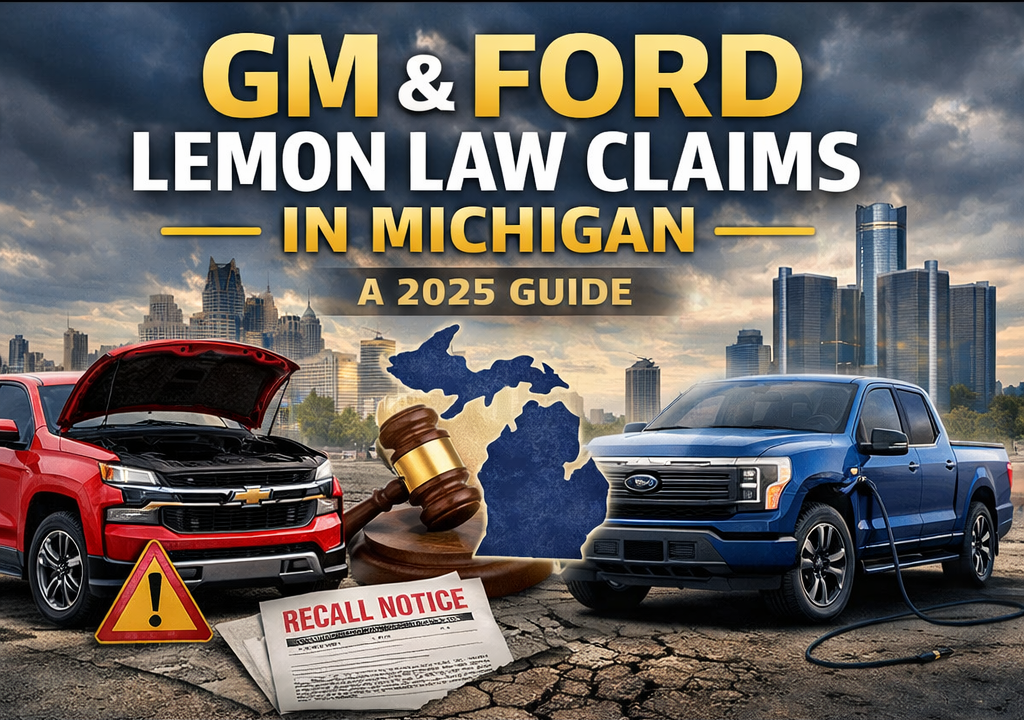
You live in the Motor City. Detroit is home to General Motors. Dearborn is where Ford was born. Michigan’s identity is built on the automotive industry—and for generations, that meant buying American, buying local, and trusting the brands that built this state.
But what happens when the Silverado you bought at your local Chevy dealer keeps breaking down? When your F-150 Lightning won’t charge? When GM’s recall “fix” didn’t actually fix anything?
You still have rights. Even in Michigan—headquarters to the automakers themselves—consumers are protected by state lemon law. And if GM or Ford can’t repair your vehicle after a reasonable number of attempts, they owe you a refund, replacement, or compensation.
This guide is specifically for Michigan residents dealing with defective GM or Ford vehicles. Our Lemon Law Michigan Attorneys are ready to help. We’ll cover Michigan’s lemon law, the major GM and Ford recalls, what to do if a recall didn’t solve your problem, and how to hold these manufacturers accountable—even in their own backyard.
Michigan’s Lemon Law: The Basics
Michigan’s lemon law is found in the Motor Vehicle Warranty Act (Act 87 of 1986). According to the Federal Trade Commission (FTC), lemon laws exist to protect consumers from defective vehicles that manufacturers fail to repair within a reasonable number of attempts.
Protection Window
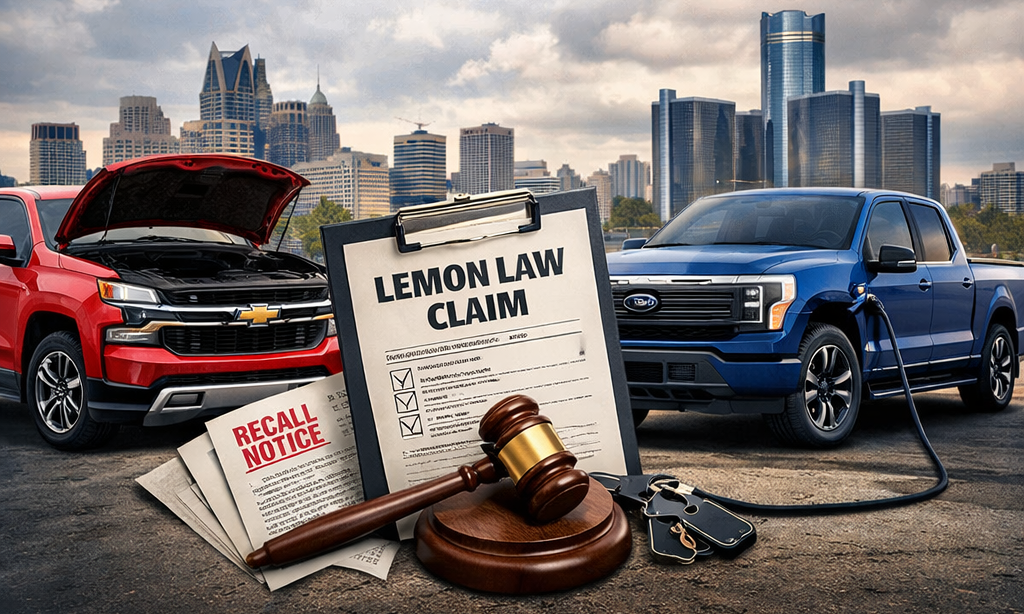
Your vehicle is covered if defects appear within the first year of ownership or during the full term of the manufacturer’s written warranty (whichever provides longer coverage). Most GM and Ford vehicles come with a 3-year/36,000-mile bumper-to-bumper warranty, so in practice, you’re protected during that full warranty period if you meet other requirements.
The 4-Repair-Attempt Rule
Michigan law presumes your vehicle is a lemon if the manufacturer or dealer has attempted to repair the same defect four or more times and the problem still isn’t fixed.
The 30-Day Rule
Alternatively, your vehicle qualifies if it’s been out of service for 30 or more cumulative days for warranty repairs. These days don’t have to be consecutive—you can add up all the time your vehicle has spent in the shop.
What You’re Entitled To
If your vehicle qualifies, the manufacturer must refund the full purchase price (minus a mileage offset) or provide a comparable replacement vehicle.
Fee-Shifting Provision
Michigan’s law includes attorney fee-shifting. If you win your case, GM or Ford pays all your attorney’s fees. You pay nothing out of pocket.
GM’s 6.2L V8 Engine Recall: What Michigan Owners Need to Know
In 2024 and 2025, General Motors issued a massive recall affecting the 6.2L V8 engine—one of the most popular powertrains in GM’s truck and SUV lineup. According to the National Highway Traffic Safety Administration (NHTSA), fuel pump module defects in these engines have posed serious safety risks, including engine stall at highway speeds.
Which Vehicles Are Affected?
• Chevrolet Silverado 1500 (2019–2024)
• GMC Sierra 1500 (2019–2024)
• Chevrolet Tahoe (2021–2024)
• Chevrolet Suburban (2021–2024)
• GMC Yukon (2021–2024)
• GMC Yukon XL (2021–2024)
• Cadillac Escalade (2021–2024)
• Cadillac Escalade ESV (2021–2024)
What’s the Problem?
The recall addresses fuel pump module failures that can cause engine stalling while driving, loss of power, inability to restart the vehicle, check engine light illumination, and rough idling or hesitation. In severe cases, the engine can shut down completely at highway speeds—a serious safety hazard.
The Recall Fix
GM’s recall involves replacing the fuel pump control module. Dealers are instructed to inspect the fuel pump module, replace the module if defective, and update vehicle software.
What If the Recall Didn’t Fix Your Problem?
A recall repair is not a magic solution. If you had your vehicle in for fuel pump issues before the recall was announced, complied with the recall but the problem persists, or are experiencing new fuel system issues after the recall repair, you may have a lemon law claim. Each service visit—before and after the recall—counts as a repair attempt. If GM can’t fix the issue after four attempts total, Michigan law says you’re entitled to relief.
Ford F-150 Lightning: Battery and Charging System Issues
Ford’s F-150 Lightning is the company’s flagship electric truck, built right here in Michigan at the Rouge Electric Vehicle Center in Dearborn. But the Lightning has experienced significant growing pains. For a deeper look at how electric vehicles are covered under state law, see our guide: EVs Under Michigan Lemon Law: Your Rights.
Common F-150 Lightning Defects
Battery Management System Failures
• Sudden loss of charge
• Battery won’t charge beyond a certain percentage
• Inaccurate range estimates
• Battery overheating warnings
Charging Port Defects
• DC fast charging doesn’t work or charges extremely slowly
• Charging port door won’t open or close
• Charging cable won’t release from the port
• Error messages when attempting to charge
Software and Infotainment Crashes
• SYNC 4A system freezes or reboots
• Loss of critical vehicle information (range, speed, battery status)
• Navigation and climate controls become unresponsive
Power Loss While Driving
• Truck suddenly loses power and enters reduced power mode
• Inability to accelerate
• Complete shutdown requiring a restart
Ford’s Response
Ford has issued several technical service bulletins (TSBs) and over-the-air software updates addressing Lightning issues. However, software updates don’t always resolve hardware defects. If your Lightning has been back to the dealer multiple times for the same issue, and Ford’s updates haven’t fixed it, you may have a lemon law case.
Chevy Bolt EV: Battery Recall History and Ongoing Issues
The Chevrolet Bolt EV and EUV were among GM’s most popular electric vehicles—until a massive battery recall.
The Battery Fire Recall
In 2020–2021, GM recalled every Chevy Bolt ever made (2017–2022 model years) due to battery fire risks. The recall involved battery module replacements, software updates to limit charging capacity as a temporary fix, and eventually full battery pack replacements for many vehicles.
Post-Recall Problems
Even after battery replacements, some Bolt owners continue to experience reduced range beyond normal degradation, charging failures or slow charging, battery management errors, and persistent warning lights. If your Bolt received a recall battery replacement but you’re still having battery or charging issues, those post-recall repair attempts count toward a lemon law claim.
When a Recall Repair Isn’t Enough: Your Lemon Law Rights
Recalls and lemon law claims are not mutually exclusive. In fact, recalls often strengthen lemon law cases.
Pre-Recall Repair Attempts Count
If you brought your vehicle in for a specific issue before GM or Ford issued a recall, those service visits are documented repair attempts.
Post-Recall Failures Count Too
If the recall repair doesn’t fix the problem—or if the issue returns after the recall repair—those additional service visits also count.
Example Timeline
1. Month 3: You report engine stalling; dealer can’t replicate issue (Attempt 1)
2. Month 6: Stalling happens again; dealer replaces a sensor (Attempt 2)
3. Month 10: GM issues recall for fuel pump; you get the recall repair done
4. Month 12: Stalling continues; dealer says recall should have fixed it (Attempt 3)
5. Month 14: Fourth service visit for the same stalling issue (Attempt 4)
Result: You’ve met Michigan’s 4-repair-attempt threshold. You have a lemon law claim. The recall doesn’t reset the count—it’s just one more attempt to fix the problem.
GM’s and Ford’s Arbitration Programs: Why You Need an Independent Attorney
Both GM and Ford operate their own arbitration programs: GM uses the National Center for Dispute Settlement (NCDS), and Ford uses the Ford Dispute Settlement Board (DSB). These manufacturer-run programs are theoretically designed to resolve lemon law disputes without litigation.
The Problem: Manufacturer Bias
These programs are funded and administered by the manufacturers themselves. While they claim to be neutral, the reality is that arbitrators are paid by GM or Ford, decisions often favor the manufacturer, consumers have limited representation, and awards are often smaller than what an independent attorney would negotiate.
You’re Not Required to Use Manufacturer Arbitration
Michigan law does not require you to go through GM’s or Ford’s arbitration program. Working with experienced Lemon Law Attorneys in Michigan gives you the right to negotiate directly with the manufacturer’s legal team and pursue litigation if a fair settlement isn’t offered.
It’s also worth understanding your federal rights. Our blog Michigan Lemon Law vs. Magnuson-Moss Act explains how state and federal warranty law can work together to strengthen your case.
The Fee-Shifting Advantage
Because Michigan’s lemon law includes fee-shifting, you pay nothing to hire an attorney. If you win, GM or Ford pays all legal fees and costs. There is zero financial downside to hiring independent representation.
Other GM and Ford Models with Known Issues
Beyond the 6.2L recall and the F-150 Lightning, other GM and Ford vehicles have documented defect patterns.
GM Vehicles
Chevy Equinox / GMC Terrain
• Timing chain failures
• Engine stalling
• Transmission hesitation
Chevy Traverse / Buick Enclave
• Transmission shuddering or slipping
• Air conditioning failures
• Electrical system malfunctions
Chevy Malibu
• Transmission issues
• Engine stalling
• Steering problems
Ford Vehicles
Ford Explorer
• Transmission vibration and shuddering (10-speed automatic)
• Engine stalling
• Electrical failures
Ford Escape
• Engine fires (subject to recall)
• Transmission issues
• Brake failures
Ford Bronco / Bronco Sport
• Roof leaks
• Engine overheating
• Transmission failures
What to Document for a GM or Ford Lemon Law Case
Documentation is the foundation of any successful lemon law case.
Essential Records
Repair Orders
Every time you take your GM or Ford vehicle in for service, get a printed repair order that includes the date and mileage, your complaint, the dealer’s diagnosis, work performed, parts replaced, and days in service.
Recall Notices and Completion Records
If your vehicle was subject to a recall, save the original recall notice, keep the receipt showing the recall repair was completed, and document any issues that occurred before and after the recall.
Written Communications
Save all emails from the dealership or manufacturer, texts or calls with service advisors, and letters you sent to GM or Ford about the defect.
Personal Log
In addition to official paperwork, maintain your own log noting when symptoms first appeared, how the defect affects your use of the vehicle, any safety concerns, and days the vehicle was in the shop. This personal narrative can be powerful evidence.
How Long Does a Michigan Lemon Law Case Take?
Most Michigan lemon law cases resolve in 3–6 months with an experienced attorney. For a full breakdown of each phase, read our detailed guide: How Long Does a Michigan Lemon Law Case Take?.
Typical Case Timeline
6. Documentation and Evaluation (2–4 weeks): Your attorney gathers all repair records and evaluates your case.
7. Demand Letter (1–2 weeks): A formal demand letter is sent to GM or Ford.
8. Manufacturer Response (30 days): Under Michigan law, the manufacturer has 30 days to respond.
9. Negotiation (4–8 weeks): Most cases settle during this phase.
10. Resolution: You receive your settlement or replacement vehicle.
If the manufacturer refuses to settle fairly, the case may proceed to litigation, which can take 6–12 months.
What You’re Entitled to If You Win
Full Refund (Buyback)
• Purchase price
• Taxes and fees
• Registration costs
• Minus a small mileage offset
Replacement Vehicle
A new, comparable GM or Ford vehicle at no cost to you.
Attorney Fees
The manufacturer pays all your attorney’s fees and costs.
Don’t Let Loyalty Cost You: Take Action
Michigan’s automotive legacy is something to be proud of. But loyalty to a brand shouldn’t mean accepting a defective vehicle. If your GM or Ford vehicle has been back to the dealer four or more times for the same issue, or has been out of service for 30+ days, you have legal rights.
Key Takeaways:
• Michigan lemon law requires 4 repair attempts or 30 days out of service
• GM’s 6.2L V8 recall affects Silverado, Sierra, Tahoe, Yukon, and Escalade
• Ford F-150 Lightning has documented battery and charging issues
• Recall repairs that don’t work count toward your lemon law case
• GM and Ford pay all attorney fees if you win—zero cost to you
• You deserve a vehicle that works, even if it’s built in your backyard
You live in the Motor City. You deserve a car that works. Contact our Lemon Law Michigan Attorneys today for a free, no-obligation consultation and find out exactly what your claim is worth.
Need help with your lemon law case? Contact us today for a free consultation.